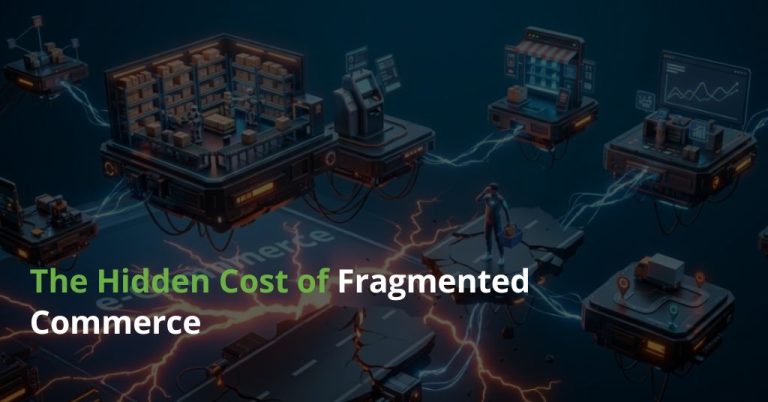
The Hidden Cost of Fragmented Commerce
Fragmentation is the dirty secret of enterprise commerce. It’s not a failure of strategy but just the result of growth. It leaks margin, delays fulfillment and burns out your operations team. And in a competitive market where order-to-delivery windows are measured in hours, not days the bill is already coming due.
Where Does the Money Actually Disappear?
The costs of a fragmented commerce stack aren’t always visible on a P&L, but they show up everywhere else. Here are the five places they hurt most:
1.Manual reconciliation overhead
When your e-commerce platform, OMS, ERP, and 3PL can’t talk to each other natively, someone has to translate. Operations teams spend anywhere from 15-40 percent of their working hours on data reconciliation and centralisation – pulling reports from one system, reformatting them, and feeding them into another.
2.Order exception handling at scale
In a unified commerce environment, an out-of-stock signal triggers automatic re-routing to an alternative fulfillment node. In a fragmented stack, it generates a manual exception ticket. This seems like a small issue at hand initially, but during peak periods, seasonal spikes this becomes your breaking point. Exception rates climb, SLAs slip and customer service queues are exploding.
3.Inventory inaccuracy
Without a real-time unified inventory view, overselling becomes inevitable. Industry data suggests that inventory inaccuracy in siloed environments averages 3 to 5 percent, which sounds small until you consider that for a business processing 50,000 orders per month, that translates to 1,500 to 2,500 orders per month that require post-purchase intervention.
4.Integration maintenance
Every point-to-point integration between systems is a liability. It was built at a moment in time, by engineers who may no longer be at your organisation. When either platform updates, the integration breaks. When the business scales, the integration degrades. Having a unified commerce cloud solution is the biggest opportunity for teams with this issue.
5.The customer experience tax
When your systems can’t share data in real time, your customers pay the price. They receive conflicting order status updates. They discover items are out of stock after purchasing. They experience delays they weren’t warned about. Each poor customer experience decreases retention and sales.
What do Unified Commerce Cloud Solutions bring?
The antidote to fragmentation isn’t a rip-and-replace approach. It’s orchestration of the stack, which is essentially building a layer that sits across your existing systems and creates the unified operating model your stack was never designed to provide.
Cloud Commerce platforms built on orchestration-first architecture like Novitates Cloud Commerce powered by Pega work by:
- Creating a single order data model that all downstream systems refer to
- Automating exception handling so that routing, re-routing, and escalation happen without human intervention
- Providing a real-time inventory signal that’s shared across channels
- Eliminating point-to-point integrations and building a managed, API-first integration framework
- Surfacing operational analytics that make the hidden costs visible and trackable
Looking to transform your commerce strategy?
Novitates helps enterprises move beyond transactions to intelligent, experience-led commerce powered by cloud, AI, and automation.
Get in touch with us by dropping us an email. To discover more about our services, visit our website: https://novitatestech.com/