
Agentic AI Belongs Inside Governed Workflows
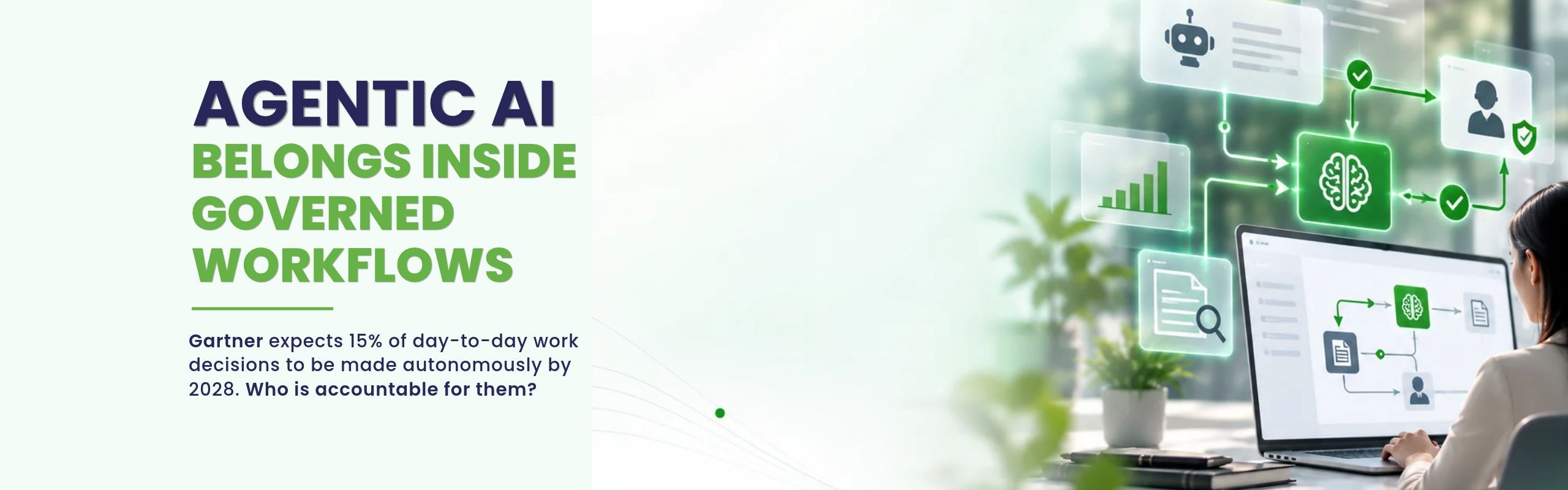
Gartner expects 15% of day-to-day work decisions to be made autonomously by 2028. Who is accountable for them?
AI agents are moving from answering questions to taking action. They classify documents, check policies, route cases and, increasingly, make decisions. Gartner expects at least 15% of day-to-day work decisions to be made autonomously through agentic AI by 2028, up from effectively none in 2024.
That shift raises a question many enterprises haven't answered yet: when an agent makes a decision, who is accountable for it?
The Hype Problem
The market is crowded. Gartner estimates that only around 130 of the thousands of vendors claiming agentic AI capabilities are real, with many rebranding existing chatbots, RPA and assistants, a practice it calls "agent washing". Gartner also expects over 40% of agentic AI projects to be cancelled by the end of 2027 because of rising costs, unclear value or inadequate risk controls.
The common thread in those failures is not intelligence. It's control. Agents that operate on enterprise data with no clear boundaries, no oversight and no audit trail are hard to trust, and harder to approve.
Why Regulated Industries Feel This First
In insurance, banking and healthcare, decisions carry regulatory weight. A declined claim, a flagged customer or a delayed authorization must be explainable to a customer, an auditor or a regulator. An agent that can't show how it reached a decision creates risk, however capable it is.
That's why agentic AI in these industries can't run alongside the workflow. It has to run inside it.
What "Governed" Looks Like in Practice
1. Orchestration at the case layer
Agents should operate inside a platform that manages the business process, such as Pega's case layer or Kore.ai's conversation layer. There, every agent action becomes a case event with full context: what happened, when, on what data and why.
2. Bounded tool access
Each agent gets access only to the systems and data its task requires. A document classifier doesn't need to approve payments. Clear boundaries limit what can go wrong.
3. Human-in-the-loop checkpoints
Not every step needs approval, but consequential ones do. Checkpoints should be calibrated to business and regulatory risk, so humans stay accountable for the decisions that matter without slowing routine work.
4. An audit trail on every action
Every agent action should be logged natively, not reconstructed afterwards. When a regulator asks how a decision was made, the answer should already exist.
5. Your licensed models, inside your tenancy
Agents should use AI models the enterprise has already approved, running inside its own environment, so data stays within existing security and compliance boundaries.
An Insurance Example
Consider a claim. Four agents work inside the claims case:
- One agent classifies incoming documents.
- Another checks the policy and coverage.
- A third flags potential fraud indicators.
- A fourth prepares a summary and recommendation.
A human adjuster then reviews the recommendation and makes the final decision on any consequential outcome.
Every step runs inside the claims case. Every action is logged. The result is faster handling without losing accountability. In one live deployment of this kind of approach, a top-10 global insurer reduced its average claims cycle from 9 days to 3.4 days.
Pre-Built Agents, Governed From Day One
Building every agent from scratch slows adoption. That's why Novitates created NovaVerse™, a growing library of pre-built Pega agents, including CLaiMX for claims intelligence, a KYC reviewer, a document classifier and an underwriting copilot. Each one drops directly into a Pega case and is audit-logged from day one.
The Bottom Line
The question isn't how autonomous an agent can be. It's how accountable.
Enterprises that put agents inside governed workflows will be the ones that move from pilots to production, and keep the trust of their customers and regulators along the way.
Sources: Gartner press release, 25 Jun 2025 (15% of day-to-day work decisions made autonomously by 2028; ~130 genuine agentic AI vendors; over 40% of agentic AI projects cancelled by end-2027). Claims metric from a Novitates live deployment.
Planning your agentic AI program?
Book a governed AI architecture session with Novitates.
Book a governed AI architecture session

Enterprise AI. Monthly.
One email a month. Pega + Kore.ai + AWS deployment patterns. No fluff.
No spam. Unsubscribe any time.