
Human and Agent. Teammates.
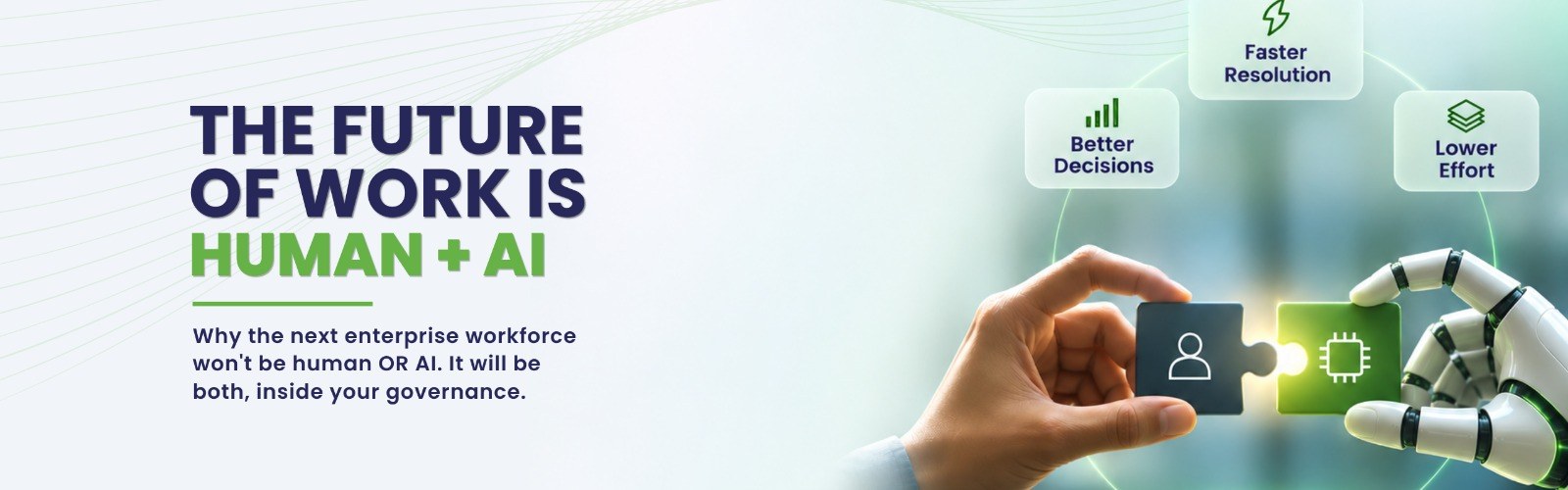
Why the next enterprise workforce won't be human OR AI. It will be both, inside your governance.
Most conversations about AI at work begin with a fear: what will it replace? It's an understandable question, but it's the wrong starting point for enterprise leaders. The more useful question is what humans and AI agents can achieve together, and what has to be true for that partnership to be trusted.
Gartner expects 40% of enterprise applications to include task-specific AI agents by the end of 2026, up from less than 5% in 2025. Agents are arriving in the tools your teams already use. That makes the operating model, not the technology, the real challenge.
From tools to teammates
The first wave of enterprise AI gave people better tools: search, summarisation, drafting. Useful, but the human still did every step of the process.
Agents are different. They can take on a defined piece of work, such as classifying a document, gathering evidence for a KYC review or preparing a claims summary, and hand it back for a decision. That shifts the relationship from "a tool I use" to "a teammate I work with". And teammates need roles, rules and accountability.
Where agents fit, and where humans must stay
A practical way to divide the work:
- Agents take on the repetitive, document-heavy, rules-driven work: intake, classification, data gathering, first-pass checks and routine decisions with clear criteria.
- Humans keep judgment, relationships, exceptions and accountability for consequential outcomes: a declined claim, a flagged customer, a credit decision, a clinical determination.
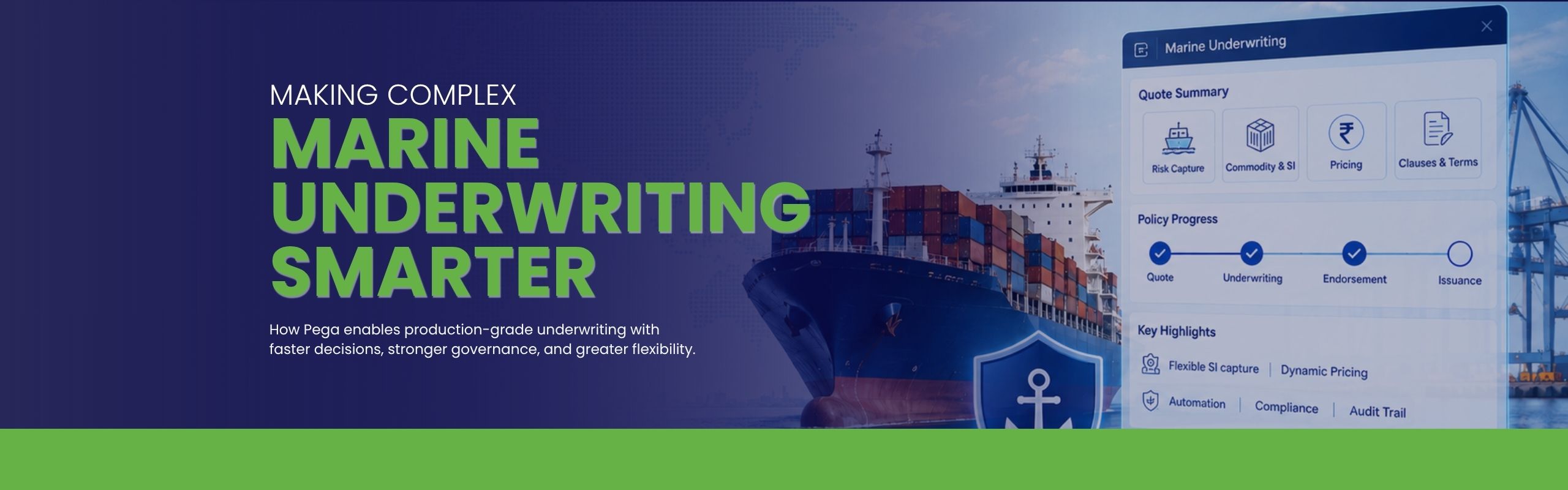
In practice, this is already producing results. In one live underwriting deployment, 41% of policies are now auto-decisioned and underwriter review time has fallen by 65%. The underwriters didn't disappear. They spend their time on the cases that genuinely need them.
Four principles for a governable digital workforce
1. No agent outside a governance layer
Agents should run inside an orchestration layer, such as Pega's case layer or Kore.ai's conversation layer, where every action becomes a logged, traceable event. An agent operating directly on enterprise data with no control plane won't pass a security review, and shouldn't.
2. Human-in-the-loop where it matters
Not every step needs human approval; that would remove the benefit. But consequential decisions do. The checkpoints should be calibrated to regulatory and business risk, not applied everywhere by default.
3. Licensed AI, inside your tenancy
Agents should use the models your enterprise has already approved, such as Azure OpenAI, AWS Bedrock or Pega's GenAI fabric, running inside your own environment. No unlicensed tools, no data leaving your boundary.
4. Accountability stays human
An agent can recommend, prepare and execute. But a named person or team remains accountable for outcomes. AI should never become a way to make responsibility disappear.
What changes for people
A human-agent team changes the shape of roles. Reviewers spend less time gathering and more time deciding. Contact centre agents get real-time context instead of searching across screens. Case workers are coached through complex processes instead of relying on memory.
That requires investment in people as much as technology: training teams to work with agents, redesigning processes around the new division of work, and measuring outcomes, not just automation rates.
How Novitates approaches it
We build human-agent teams on Pega and Kore.ai, with pre-built, audit-logged agents from our NovaVerse™ library and a 90-day path to a live outcome through NovaPath™. We also practise what we describe: every Novitates engineer is AI-fluent, working inside our clients' tenancies, on their data, under their governance.
The bottom line
The future of work isn't human versus machine. It's human with machine, inside a governance model that makes the partnership trustworthy. The enterprises that design for that now will be the ones whose agents actually reach production.
Ready to design your digital workforce? Book a working session with Novitates at www.novitatestech.com.
Source: Gartner press release, 26 Aug 2025 (40% of enterprise apps with task-specific AI agents by end of 2026). Underwriting metrics from a Novitates live deployment.
Ready to ship this in your enterprise?
Talk to the Novitates team about what this looks like inside your Pega or Kore.ai environment.
Book a working session
Enterprise AI. Monthly.
One email a month. Pega + Kore.ai + AWS deployment patterns. No fluff.
No spam. Unsubscribe any time.